
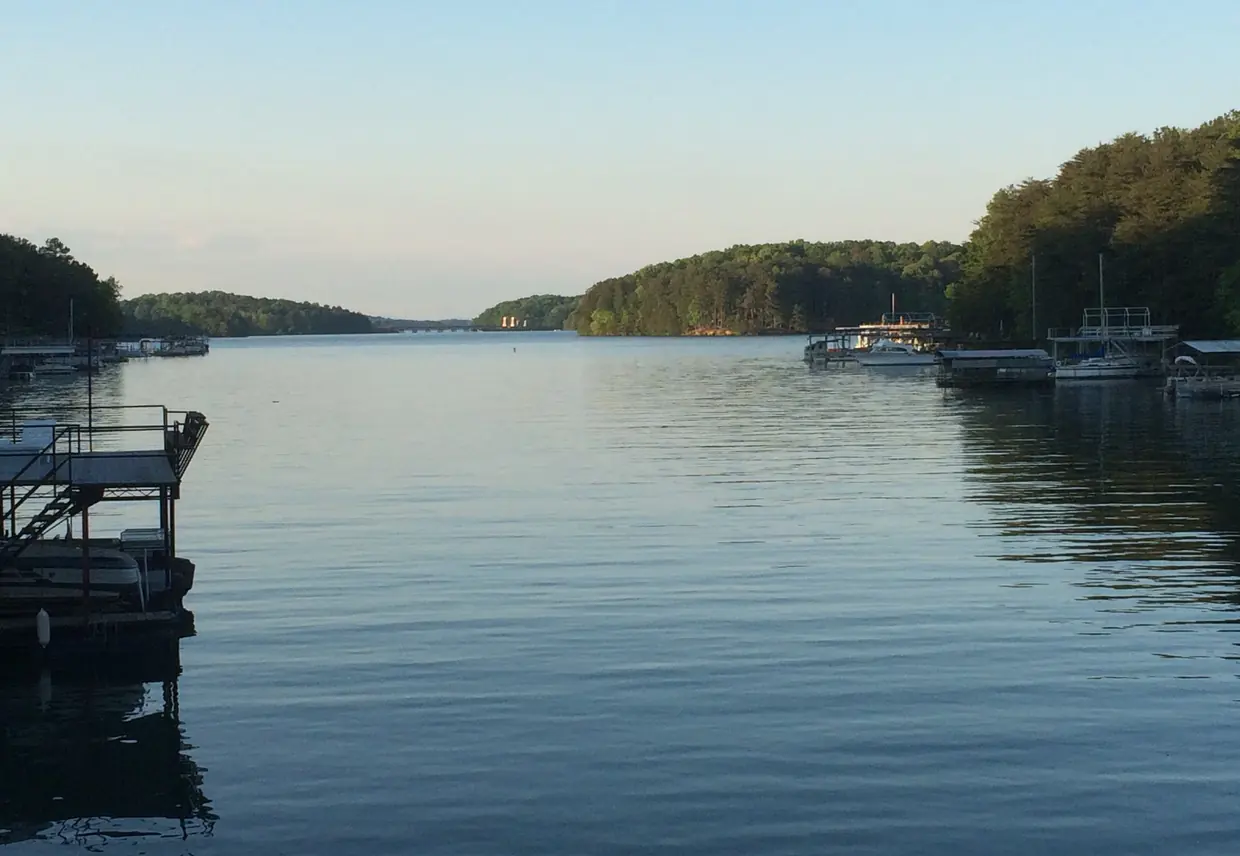
Buying a Lake Lanier house with a dock is two deals that look like one. The seller sells you the house, the lot and the dock structure. The permission to keep that structure on federal land is a permit the Corps gave the seller, and it ends at your closing. This guide covers the whole lake, in the order a buyer runs into the rules.
The permit is the Corps’ document; the dock is private property
Two different things
- A Shoreline Use Permit or License is a legal instrument owned by the Corps that lets a private person or association place facilities on Lake Lanier. The dock itself is the permit holder's private property on public land; the Corps cannot handle trespassers on a dock (that goes to local police). U.S. Army Corps of Engineers (archived page), checked 2026-10-19
- The U.S. government (the Army Corps of Engineers) owns most of the land around Lake Lanier outright, in fee title. On most 'lakefront' lots the private property line stops at the Corps boundary, not at the water. U.S. Army Corps of Engineers (archived page), checked 2026-10-19
- Private property lines do not extend onto Corps land. Owning the lot next to it gives no special rights on government property, no guaranteed privacy and no exclusive use of the shoreline. U.S. Army Corps of Engineers (archived page), checked 2026-10-19
That split explains most of what follows. The floating structure is property a seller can sell you. The right to keep it on Corps land is a permit only the Corps can issue, and it issues it to a person who owns the adjoining land, not to the lot. Between your property line and the water there is usually a strip of public land, and the dock, its walkway and any power line all cross it.
Where a lakefront lot ends
Five lines decide what you are actually buying.
Step through the cross-section. Each line comes from the Corps’ own documents, with the link to check it.
1 The deed usually stops short of the water
The U.S. government (the Army Corps of Engineers) owns most of the land around Lake Lanier outright, in fee title. On most 'lakefront' lots the private property line stops at the Corps boundary, not at the water.
Source: U.S. Army Corps of Engineers (archived page), checked 2026-10-19
Find the lines on a survey2 The shore belongs to the public
Private property lines do not extend onto Corps land. Owning the lot next to it gives no special rights on government property, no guaranteed privacy and no exclusive use of the shoreline.
Source: U.S. Army Corps of Engineers (archived page), checked 2026-10-19
How the shoreline is zoned3 1,071 feet is full, and the lake moves
Lake Lanier's full level is 1,071 feet above mean sea level. The Corps calls 1,070 feet winter pool.
Source: U.S. Army Corps of Engineers (archived page), checked 2026-10-19
Water levels for buyers4 The flood line can cross private land
When Buford Dam was built, the government set a maximum flood elevation of 1,085 feet above mean sea level. Where that line fell on private land, it bought flowage easements. That land stays private, but the owner may not build habitable structures on it or change its contour. All purchased easements are recorded.
Source: U.S. Army Corps of Engineers (archived page), checked 2026-10-19
The 1,085-foot line5 The dock is a permit, and it ends at the sale
Dock permits cannot be transferred. They become null and void when the property is sold or transferred, or when the permit holder dies. New owners must tell the Corps of their purchase and apply for a new permit.
Source: U.S. Army Corps of Engineers (archived page), checked 2026-10-19
Dock permits for buyers
The cross-section shows where a lakefront lot usually ends: the deed line at the Corps boundary, the Corps strip, full pool and the 1,085-foot line, and the dock out on the water. Read our guide to the 1,085 line for the easement part of that picture.
Why the seller’s permit ends at closing
Nontransferable and void on sale
- Shoreline permits and licenses at Lake Lanier last at most five years and cannot be transferred. They give no real estate rights and no exclusive use of government property, and Lanier's shoreline stays open to the public. U.S. Army Corps of Engineers (archived page), checked 2026-10-19
- Dock permits cannot be transferred. They become null and void when the property is sold or transferred, or when the permit holder dies. New owners must tell the Corps of their purchase and apply for a new permit. U.S. Army Corps of Engineers (archived page), checked 2026-10-19
- The Corps' welcome letter to buyers says the dock permit expired the day the name on the deed changed, and tells new owners not to install or change facilities or cut vegetation or trees until they contact the office and get written permission. U.S. Army Corps of Engineers (archived page), checked 2026-10-19
Put together, the working rule is simple. From the day the deed changes to your name, nobody holds a permit for that dock until the Corps issues one to you. Until it writes back, do not add to the dock, move it, run new wiring or cut anything on the shoreline. The Corps’ welcome letter says exactly that.
“In good standing” does not exist
The Corps says there is no such thing as a permit 'in good standing': a permit is either active or expired. A buyer can call the Shoreline Help Desk or area ranger for general information about a dock, but privacy rules limit what the Corps can share. (U.S. Army Corps of Engineers (archived page), checked 2026-10-19)
Listings sometimes describe a dock permit as current or in good standing. The Corps’ own answer is that a permit is either active or expired, and it ends at the sale either way. What you can usefully learn before closing is general information: whether the Corps has a permit history for that shoreline and whether it knows of problems. Call with the seller’s permit number and the lake address, and expect privacy limits on what it can tell you.
Your agent cannot approve anything
The Corps warns buyers ('Buyer be ware!') that a real estate agent has no authority to approve anything about Lake Lanier permits. If the seller or an agent made unapproved changes to the dock or shoreline, the buyer may be required to correct them. (U.S. Army Corps of Engineers (archived page), checked 2026-10-19)
This is the rule that costs buyers money. If an earlier owner added a deck section, ran power, cut a view, laid a path or left furniture on Corps land without approval, the ranger can find it during your inspection and require you to correct it. Walk the shoreline early in due diligence and compare what you see with the seller’s permit, so a repair can be part of the negotiation instead of a surprise after closing.
The change-of-owner process
For the change-of-owner process the Corps asks for, all at once: the recorded deed with its tax stamp (not a security deed), the current recorded survey or plat with boundary information, your own hand drawing of the dock with all dimensions, a hand-drawn site map, the electrical certification if the permit requires one, and proof of authority for a company, trust, estate, HOA or LLC (and any power of attorney). County aerials, Google maps, the previous owner's drawings and photos are not accepted. (U.S. Army Corps of Engineers (archived page), checked 2026-10-19)
The Corps' fillable change-of-owner letter asks new owners to send everything at one time, assigns an Area Ranger once documents arrive, and warns that this is a lengthy process. Requests to upgrade, add electrical or modify the dock must be recommended by the ranger and approved in writing before installation. (U.S. Army Corps of Engineers (archived page), checked 2026-10-19)
After the documents arrive, the area ranger inspects the dock and shoreline for deficiencies and violations under the Shoreline Management Plan and 36 CFR 327. The applicant must be one person named on the newest recorded deed. (U.S. Army Corps of Engineers (archived page), checked 2026-10-19)
For a buyer, the Corps assigns the Area Ranger when it receives the change-of-owner documents. Questions can go to the Shoreline Help Desk at (770) 904-3262 if the ranger is unavailable. (U.S. Army Corps of Engineers (archived page), checked 2026-10-19)
| When | What you do | Why it matters |
|---|---|---|
| Before the offer | Ask for the seller’s permit number, a copy of the permit and any Corps letters. Call the Shoreline Help Desk with the lake address. | There is no permit “in good standing,” so ask what the Corps can share. |
| Due diligence | Walk the shoreline. List what sits on Corps land: steps, paths, power, furniture, cleared areas. Ask whether the permit requires electrical certification. | The ranger inspects for deficiencies and violations after you apply. |
| Closing | Collect the recorded deed with its tax stamp and the recorded survey or plat with boundary information. | The Corps does not accept a security deed, county aerials or the previous owner’s drawings. |
| Right after closing | Send the whole package at one time, including your own hand drawings of the dock and site. | The Corps assigns an Area Ranger when the documents arrive. |
| Inspection | Meet the ranger and fix any deficiencies the ranger lists. | Your new permit depends on it. |
| Permit issued | Wait for the signed permit before any work on the dock or the shoreline. | A site visit is not approval. |
The Corps estimates about 6 to 8 weeks to evaluate and process a permit application once it has the complete package. (U.S. Army Corps of Engineers (archived page), checked 2026-10-19)
Meeting the ranger at the lot is not approval. The Corps says not to put in a dock, power line or walkway until you receive a copy of the signed permit, and it returns incomplete applications and checks. (U.S. Army Corps of Engineers (archived page), checked 2026-10-19)
Build the calendar around those estimates. If you plan to replace dock sections, add a lift, upgrade the wiring or add a walkway, the request goes through the ranger and needs written approval before anything is installed. The applicant must be named on the newest recorded deed, so decide early whose name goes on it.
Electrical service on the dock
All dock electrical service on Corps land must have ground-fault (GFI) protection and be buried, regardless of age or grandfathered status. Electrical recertification is required at each permit renewal, at each change of ownership, and whenever an inspection finds the service out of compliance. (U.S. Army Corps of Engineers (archived page), checked 2026-10-19)
The Corps' Mobile District announced on Sept. 21, 2026 that, beginning Oct. 1, 2026, Exhibit C will no longer be used. Shoreline Use Permit holders instead submit a letter from a state-licensed electrical contractor certifying that the dock's electrical service complies with current National Electrical Code requirements. The electrical requirements themselves did not change, only the paperwork. Exhibit C is being removed from permit packages for renewals, modifications and changes of ownership; packages mailed before Oct. 1, 2026 are still processed with Exhibit C. The approved administrative change rewrites Shoreline Management Plan Section 15.3.10, marked effective Jan. 1, 2027: the contractor's letter is required at each change of ownership, electrical modification and permit renewal, must be an original no more than 3 months old, and must list the permit number, the electrical components inspected, the contractor's printed name, signature and Georgia license number, and the inspection date. Exhibit C (Exhibit 3) and all references to it were deleted from the plan. (U.S. Army Corps of Engineers, checked 2026-10-21)
The Corps' Lake Lanier electrical contractors list says all electrical installations must be approved by the Corps and inspected by a Georgia-licensed electrician, and must meet Corps specifications and the National Electrical Code. The Corps does not recommend contractors. (U.S. Army Corps of Engineers (archived page), checked 2026-10-19)
Two dates apply. The Corps stopped using Exhibit C on Oct. 1, 2026, and the rewritten plan text is marked effective Jan. 1, 2027. A package mailed before Oct. 1 is still processed with Exhibit C. If your permit includes power, ask the Corps office which version applies to your package before you hire an electrician.
For a buyer this is a timing question. Recertification is due at change of ownership when the permit includes power, so line up a Georgia-licensed electrician during due diligence and price any repairs into your offer. The Corps does not recommend contractors, so choose your own.
When the dock itself is sold or moved
Because the dock structure is private property but the permit is not, the Corps has a Dock Disposal/Transfer Form for an owner who will sell, dispose of or move a dock, naming the new responsible party and including a current photo of the dock for the area ranger. (U.S. Army Corps of Engineers (archived page), checked 2026-10-19)
Because the structure is private property, a seller who keeps the dock, moves it or sells it to someone else uses this form. If the listing says the dock stays, make sure the purchase contract says the structure is included, and ask whether the seller has filed anything naming a new responsible party. None of that gives you a permit; it only settles who owns the structure.
Who can hold a dock permit
Eligibility
- Only owners of property next to public land zoned 'limited development' may apply for a Shoreline Use Permit/License. First-time applicants for new facilities must meet a ranger on site. New owners of existing facilities apply at the Corps office. The Corps starts permit renewals itself. U.S. Army Corps of Engineers (archived page), checked 2026-10-19
- Only one dock permit is allowed per household. Permits are not issued for speculation, to enhance private property, to people renting the property, or to minors; the permit holder must own and be the main user of the dock. U.S. Army Corps of Engineers (archived page), checked 2026-10-19
- For a new private dock permit, the lot must have at least 82 feet of private land adjoining public property, with unrestricted legal access to 'Limited Development' land. The rule is not meant to apply to existing platted lots that were already eligible, unless modified. U.S. Army Corps of Engineers (archived page), checked 2026-10-19
Two of these rules catch buyers. The permit holder has to own the dock and be its main user, so a permit is not issued to someone renting the house. And if your household already holds a Lake Lanier dock permit somewhere else, ask the Corps how the one-per-household rule applies before you buy a second lake home. If the buyer is a company, trust or LLC, the change-of-owner list asks for proof of authority; ask the Corps how the ownership and main-user rules apply before you choose how to take title.
Lots with no dock today
The dock cap
- A Corps carrying-capacity study set the maximum number of private boat docks on Lanier's Limited Development shoreline at 10,615. The plan says no new permit requests will be accepted once that total is reached. At the time (2002) there were 8,593 docks counted, and two community-dock slips count as one permit. U.S. Army Corps of Engineers (archived page), checked 2026-10-19
- Once the 10,615 limit is reached, no more permits are issued. If permits free up (through attrition or revocation), the Corps announces them publicly and issues them first come, first served, repeating the process each year beginning the second Monday in March. If none free up, it issues a press release saying so. U.S. Army Corps of Engineers (archived page), checked 2026-10-19
- The Corps caps how many shoreline permits can exist on the lake at one time. When none are available, applicants can ask to be put on a wait-list. U.S. Army Corps of Engineers (archived page), checked 2026-10-19
We could not find a current count of permits against that cap. If the lot has no dock, treat a future dock as a question, not a feature: ask the Corps about the shoreline in front of that lot, its zoning and the wait-list before you set your price. Our shoreline zoning guide explains which zones can carry a private dock, and can you still get a new dock covers the cap in detail.
What a dock can be
Dock rules in the 2004 plan
- New private docks must be open-sided (no walls) and may not exceed 32 by 32 feet, including any attached deck. The slip may not exceed 20 feet wide by 28 feet long, any attached deck may not exceed 192 square feet, and the smallest dock permitted is 18 by 24 feet with a 10-by-20-foot slip. U.S. Army Corps of Engineers (archived page), checked 2026-10-19
- Single-level dock roofs, and an upper sundeck with a full safety rail, are allowed. Any covering that creates a second-level roof or room, in whole or in part, is prohibited. Roof pitch may not exceed 3 in 12. U.S. Army Corps of Engineers (archived page), checked 2026-10-19
- Permit holders may not rent out space at a private dock, and a boat may not be moored to another boat. Boats too large for the dock to moor safely must be kept at a marina. U.S. Army Corps of Engineers (archived page), checked 2026-10-19
If you are picturing an enclosed boathouse, a second-story room or renting a slip to a neighbor, plan around these rules instead. An existing dock that differs from them is a question for the ranger, not something to assume is approved.
Fees
A Corps applicant guide revised December 2012 listed a $35 five-year rate for a floating facility (dock), $35 each for electric, water and phone lines and pumps, and administrative fees of $365 for a new permit or change of ownership, $140 for a reissue and $90 for a modification, with rates 'subject to change'. (U.S. Army Corps of Engineers (archived page), checked 2026-10-19)
Those amounts come from a guide revised in December 2012, and the Corps marked them subject to change. Confirm current permit and administrative fees with the Corps office before you budget for them.
What to ask the seller before you sign
- The dock permit number, a copy of the current permit and any letters from the Corps.
- Whether the permit includes electrical service and when the wiring was last certified.
- A list of everything on Corps land: steps, paths, power, lights, benches, swings, boat trailers.
- Whether any changes were made to the dock or shoreline without written Corps approval.
- The recorded survey or plat that shows the Corps boundary.
- For a newer subdivision, the community dock permit and the slip rules from the HOA.
- Whether the dock structure is included in the sale, in writing.
Who to call
The Corps' Lake Lanier Project Management Office is at 1050 Buford Dam Road, Buford, GA 30518, phone 770-945-9531. The Shoreline Help Desk is (770) 904-3262. Shoreline mail goes to P.O. Box 567, Buford, GA 30515-0567. (U.S. Army Corps of Engineers (archived page), checked 2026-10-19)
The Corps splits Lake Lanier's shoreline management into six ranger areas, each with its own phone and email: Area 1 770-904-3273, Area 2 770-904-3272, Area 3 770-904-3269, Area 4 770-904-3263, Area 5 770-904-3287, Area 6 770-904-3258 (emails lanierslm-area1@usace.army.mil through lanierslm-area6@usace.army.mil). (U.S. Army Corps of Engineers (archived page), checked 2026-10-19)
Six Corps ranger areas
Shoreline management by area of the lake
Source: U.S. Army Corps of Engineers (archived page), checked 2026-10-19
Shoreline Help Desk
Which ranger covers a lot, general dock questions
Source: U.S. Army Corps of Engineers (archived page), checked 2026-10-19
If you do not know which ranger area covers the lot, call the Shoreline Help Desk with the lake address. You can read the rules yourself on the Corps Lake Lanier shoreline management page.
Questions buyers ask
Does a Lake Lanier dock permit transfer when I buy the house?
Dock permits cannot be transferred. They become null and void when the property is sold or transferred, or when the permit holder dies. New owners must tell the Corps of their purchase and apply for a new permit.
Who can apply for a dock permit on Lake Lanier?
Only owners of property next to public land zoned 'limited development' may apply for a Shoreline Use Permit/License. First-time applicants for new facilities must meet a ranger on site. New owners of existing facilities apply at the Corps office. The Corps starts permit renewals itself.
Which shoreline can have a private dock?
Private docks and other private shoreline uses can be permitted only on shoreline zoned 'Limited Development' (green on the allocation map), and even there the public cannot be kept off the shoreline. Permit holders who try to block public use face enforcement and permit revocation.
How many private docks can Lake Lanier have?
A Corps carrying-capacity study set the maximum number of private boat docks on Lanier's Limited Development shoreline at 10,615. The plan says no new permit requests will be accepted once that total is reached. At the time (2002) there were 8,593 docks counted, and two community-dock slips count as one permit.
What happens once the dock limit is reached?
Once the 10,615 limit is reached, no more permits are issued. If permits free up (through attrition or revocation), the Corps announces them publicly and issues them first come, first served, repeating the process each year beginning the second Monday in March. If none free up, it issues a press release saying so.
How much lake frontage does a lot need for a new private dock?
For a new private dock permit, the lot must have at least 82 feet of private land adjoining public property, with unrestricted legal access to 'Limited Development' land. The rule is not meant to apply to existing platted lots that were already eligible, unless modified.
What does a buyer send the Corps after closing on a lake home?
For the change-of-owner process the Corps asks for, all at once: the recorded deed with its tax stamp (not a security deed), the current recorded survey or plat with boundary information, your own hand drawing of the dock with all dimensions, a hand-drawn site map, the electrical certification if the permit requires one, and proof of authority for a company, trust, estate, HOA or LLC (and any power of attorney). County aerials, Google maps, the previous owner's drawings and photos are not accepted.
Can I change the dock or clear brush right after I close?
The Corps' welcome letter to buyers says the dock permit expired the day the name on the deed changed, and tells new owners not to install or change facilities or cut vegetation or trees until they contact the office and get written permission.
Can my real estate agent confirm the dock is approved?
The Corps warns buyers ('Buyer be ware!') that a real estate agent has no authority to approve anything about Lake Lanier permits. If the seller or an agent made unapproved changes to the dock or shoreline, the buyer may be required to correct them.
Is there such a thing as a dock permit in good standing?
The Corps says there is no such thing as a permit 'in good standing': a permit is either active or expired. A buyer can call the Shoreline Help Desk or area ranger for general information about a dock, but privacy rules limit what the Corps can share.
How long does the Corps take to process a permit?
The Corps estimates about 6 to 8 weeks to evaluate and process a permit application once it has the complete package.
How big can a new private dock be on Lake Lanier?
New private docks must be open-sided (no walls) and may not exceed 32 by 32 feet, including any attached deck. The slip may not exceed 20 feet wide by 28 feet long, any attached deck may not exceed 192 square feet, and the smallest dock permitted is 18 by 24 feet with a 10-by-20-foot slip.
Can a Lake Lanier dock have a second story?
Single-level dock roofs, and an upper sundeck with a full safety rail, are allowed. Any covering that creates a second-level roof or room, in whole or in part, is prohibited. Roof pitch may not exceed 3 in 12.
Does the dock’s electrical service need recertifying when the house sells?
All dock electrical service on Corps land must have ground-fault (GFI) protection and be buried, regardless of age or grandfathered status. Electrical recertification is required at each permit renewal, at each change of ownership, and whenever an inspection finds the service out of compliance.
How deep must the water be under a new dock?
The 2004 plan requires six feet of water under the lakeside or slip end of a dock (at full pool, per Section 15.3.4), and says that requirement is subject to change.
Can I move my dock out when the lake drops?
During low water, docks may be moved to follow the receding shoreline if one-third of the channel stays open and they do not cross neighbors or move into Protected or Recreation shoreline. Digging, leveling or changing the lakebed contour without a permit is prohibited.
Can I rent out space at my dock?
Permit holders may not rent out space at a private dock, and a boat may not be moored to another boat. Boats too large for the dock to moor safely must be kept at a marina.
What does the Corps say about selling a dock separately?
Because the dock structure is private property but the permit is not, the Corps has a Dock Disposal/Transfer Form for an owner who will sell, dispose of or move a dock, naming the new responsible party and including a current photo of the dock for the area ranger.
Next step
Run the address through the waterfront due-diligence checker, then read does a Lake Lanier dock permit transfer for the closing-day detail and check the water depth at the dock with the dock-depth planner.
Rules, rates, maps and lake levels change. Every rule on this page links to the office that sets it; confirm with that office before you rely on it.