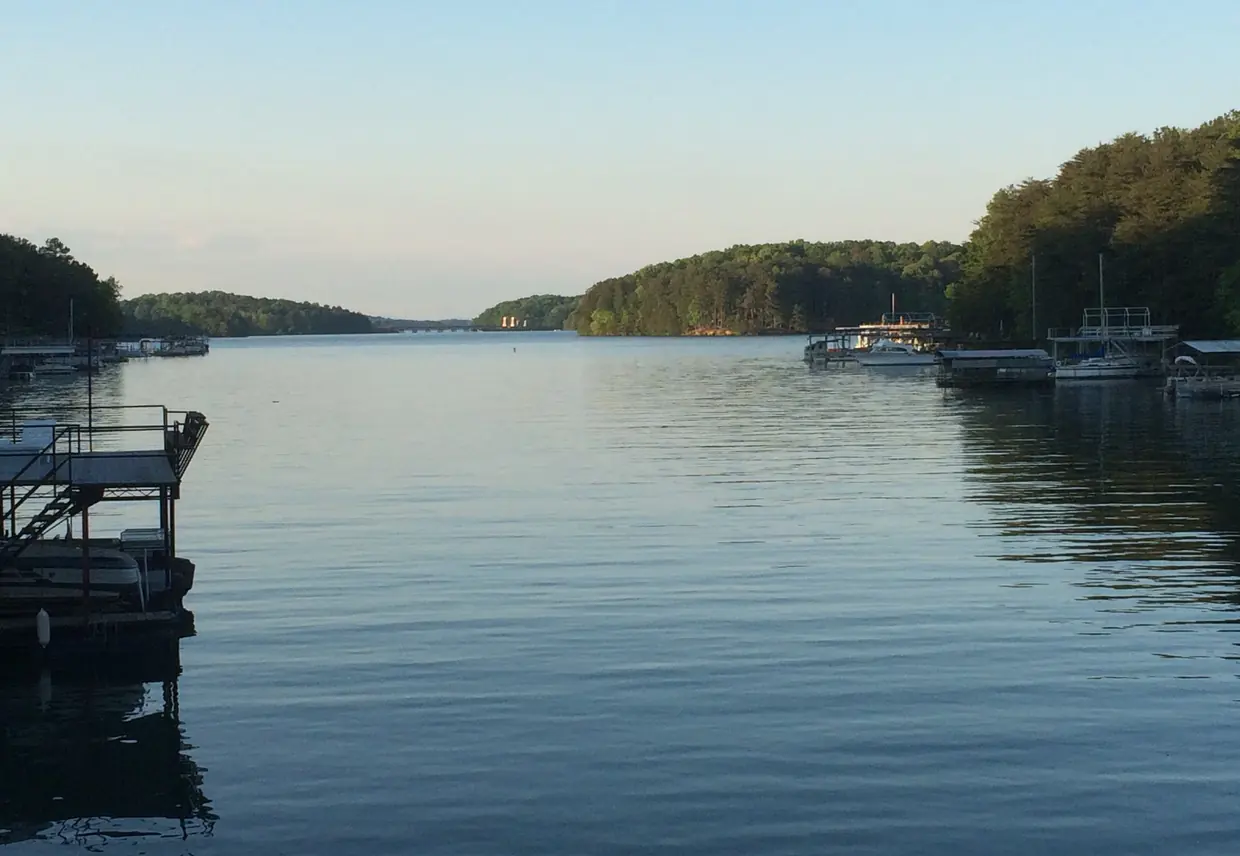
Buyers looking at a lot or a house without a dock ask this more than anything else, and online posts offering a “permit for sale” add to the confusion. The answer depends on a lake-wide limit, the lot’s own frontage and zoning, and when the development was platted. Here is how each one works.
The cap
A Corps carrying-capacity study set the maximum number of private boat docks on Lanier's Limited Development shoreline at 10,615. The plan says no new permit requests will be accepted once that total is reached. At the time (2002) there were 8,593 docks counted, and two community-dock slips count as one permit. (U.S. Army Corps of Engineers (archived page), checked 2026-10-19)
Those counts come from the plan. We could not confirm how many permits exist today against the cap, so ask the Corps directly whether a permit could be available for the shoreline in front of the lot you are considering.
The Corps caps how many shoreline permits can exist on the lake at one time. When none are available, applicants can ask to be put on a wait-list. (U.S. Army Corps of Engineers (archived page), checked 2026-10-19)
What to ask about the wait-list
- Is there a wait-list for this part of the lake, and how do I join it?
- Does joining require a site appointment first, or only an application?
- How will I hear about freed-up permits, and what do I need ready when I do?
- Does anything about this lot’s frontage or zoning rule it out before I wait?
The annual March release
Once the 10,615 limit is reached, no more permits are issued. If permits free up (through attrition or revocation), the Corps announces them publicly and issues them first come, first served, repeating the process each year beginning the second Monday in March. If none free up, it issues a press release saying so. (U.S. Army Corps of Engineers (archived page), checked 2026-10-19)
That process was added to the plan as an administrative change, alongside the community-dock rules discussed below.
The Corps' 'Sec 15.1 Change' document adds two administrative changes to the 2004 plan, both effective Oct. 19, 2012 after public review: Section 15.1.1 (community dock permits) and Section 12.1 (how permits are handled once the dock cap is reached). It repeats the 2004 Section 15.1 opening text unchanged: Limited Development only, five-year maximum, non-transferable, void on sale. (U.S. Army Corps of Engineers (archived page), checked 2026-10-19)
The current text describes a first-come, first-served release, not a drawing. If no permits free up in a year, the Corps says so publicly. Either way, a release only matters to a lot that already qualifies.
The lot has to qualify first
Private docks and other private shoreline uses can be permitted only on shoreline zoned 'Limited Development' (green on the allocation map), and even there the public cannot be kept off the shoreline. Permit holders who try to block public use face enforcement and permit revocation. (U.S. Army Corps of Engineers (archived page), checked 2026-10-19)
For a new private dock permit, the lot must have at least 82 feet of private land adjoining public property, with unrestricted legal access to 'Limited Development' land. The rule is not meant to apply to existing platted lots that were already eligible, unless modified. (U.S. Army Corps of Engineers (archived page), checked 2026-10-19)
The 82 feet is frontage, not spacing between docks. It is measured along private land that adjoins Corps land, and the access has to reach Limited Development shoreline. Older platted lots that were already eligible are treated differently, so ask the Corps how the rule applies to a specific lot.
A site appointment with the area ranger is required before a private dock permit is issued. If the site qualifies, the location is reserved for 90 days from the appointment; if the application is not received in that time, the reservation lapses. (U.S. Army Corps of Engineers (archived page), checked 2026-10-19)
Where the dock could go
Placement rules
- A dock must sit at the point of shoreline nearest the owner's private property. The Corps may allow up to 100 feet left or right of that point for water depth or spacing, but not a placement that crosses past neighboring docks. U.S. Army Corps of Engineers (archived page), checked 2026-10-19
- A new dock location must leave at least a 50-foot buffer from existing or proposed structures at full pool, measured nearest point to nearest point, including across a cove. U.S. Army Corps of Engineers (archived page), checked 2026-10-19
- At a private dock site the center one-third of the cove or channel must stay open for navigation (one-half for community docks). No dock or moored boat may extend into that channel at full pool. U.S. Army Corps of Engineers (archived page), checked 2026-10-19
In a narrow or crowded cove, those three rules together can leave no legal spot even when the frontage qualifies. The ranger decides that on site.
Ask these questions before you go under contract if you can, and no later than the first days of your due-diligence period. A Corps answer on zoning, frontage and placement takes a site visit, and the reservation clock only starts once the ranger has seen the site. A lot that fails any one of these tests will not be helped by a place on the wait-list.
New developments get community docks
Community docks are the Corps' preferred form of shoreline access and are required for new residential developments (final plat approved after the 2004 plan took effect) where they reduce environmental impact, including all PUDs. After a community dock permit is issued, the rest of that shoreline is rezoned 'Protected' and no new private docks are allowed there. (U.S. Army Corps of Engineers (archived page), checked 2026-10-19)
When new docks are requested for a development, the Corps measures the total shoreline frontage. If the multi-slip dock fits within 20 percent or less of it, leaving 80 percent or more to be rezoned Protected, a community dock is required. (U.S. Army Corps of Engineers (archived page), checked 2026-10-19)
Under the 2012 change (Section 15.1.1), a developer can get only a conditional community dock permit on a preliminary plat. The dock may not be built until the local government approves the final plat and the Corps issues a non-conditional permit; without a final plat the permit will not be reissued. (U.S. Army Corps of Engineers (archived page), checked 2026-10-19)
If you are buying in a subdivision still being built, ask the developer three things: whether the community dock permit is conditional or final, whether the final plat is approved, and how slips are assigned. A conditional permit means the dock may not be built yet.
A homeowners association can apply for a shared courtesy dock where private land gives common access to Corps land. Courtesy docks are for all residents, for courtesy use only (no overnight storage or mooring), and may not exceed 192 square feet. (U.S. Army Corps of Engineers (archived page), checked 2026-10-19)
A courtesy dock is for short stops, not for keeping a boat. If a listing mentions one, it is not a slip.
A slip is not a private dock
A slip in a community dock gives you a place to keep a boat under the community’s permit. It is not a private dock permit in your name, and the rules for the slip come from the permit holder and the Corps. Ask for both in writing before you count a slip as part of what you are buying.
Why you cannot buy a permit on its own
A Shoreline Use Permit or License is a legal instrument owned by the Corps that lets a private person or association place facilities on Lake Lanier. The dock itself is the permit holder's private property on public land; the Corps cannot handle trespassers on a dock (that goes to local police). (U.S. Army Corps of Engineers (archived page), checked 2026-10-19)
Because the permit belongs to the Corps, there is nothing for a private seller to sell. The dock structure can change hands, and the Corps has a form for that, but the permission to keep it on public land does not.
Because the dock structure is private property but the permit is not, the Corps has a Dock Disposal/Transfer Form for an owner who will sell, dispose of or move a dock, naming the new responsible party and including a current photo of the dock for the area ranger. (U.S. Army Corps of Engineers (archived page), checked 2026-10-19)
Only one dock permit is allowed per household. Permits are not issued for speculation, to enhance private property, to people renting the property, or to minors; the permit holder must own and be the main user of the dock. (U.S. Army Corps of Engineers (archived page), checked 2026-10-19)
That one-per-household rule also rules out holding a second permit for a lot you own as an investment. Permits are not issued for speculation or to add value to a property.
The “permit for sale” posts
Posts offering a dock permit or a slip for sale show up in local groups from time to time. Read them with the rules above in mind. What a private seller can offer is a dock structure, or a place in a shared dock under someone else’s permit. Neither puts a permit in your name, and a structure without a permit has nowhere legal to sit on Lanier.
A house with a dock or a lot without one
These are two different paths. Buying a home with an existing dock puts you in the change-of-owner process: the seller’s permit ends, you apply as a new owner of an existing facility, and the Corps inspects. Buying a lot without a dock puts you in the cap, the wait-list and the site rules described here, with no promise of an outcome. If a dock is the reason you are buying on the lake, the first path is the one with an answer you can check before closing.
If a permit is possible, what you can build
New private docks must be open-sided (no walls) and may not exceed 32 by 32 feet, including any attached deck. The slip may not exceed 20 feet wide by 28 feet long, any attached deck may not exceed 192 square feet, and the smallest dock permitted is 18 by 24 feet with a 10-by-20-foot slip. (U.S. Army Corps of Engineers (archived page), checked 2026-10-19)
New private docks must be open-sided, with no walls, and stay inside those dimensions. Sketch any dock you hope to build against these limits before you count on it.
Questions buyers ask
Does a Lake Lanier dock permit transfer when I buy the house?
Dock permits cannot be transferred. They become null and void when the property is sold or transferred, or when the permit holder dies. New owners must tell the Corps of their purchase and apply for a new permit.
Who can apply for a dock permit on Lake Lanier?
Only owners of property next to public land zoned 'limited development' may apply for a Shoreline Use Permit/License. First-time applicants for new facilities must meet a ranger on site. New owners of existing facilities apply at the Corps office. The Corps starts permit renewals itself.
Which shoreline can have a private dock?
Private docks and other private shoreline uses can be permitted only on shoreline zoned 'Limited Development' (green on the allocation map), and even there the public cannot be kept off the shoreline. Permit holders who try to block public use face enforcement and permit revocation.
How many private docks can Lake Lanier have?
A Corps carrying-capacity study set the maximum number of private boat docks on Lanier's Limited Development shoreline at 10,615. The plan says no new permit requests will be accepted once that total is reached. At the time (2002) there were 8,593 docks counted, and two community-dock slips count as one permit.
What happens once the dock limit is reached?
Once the 10,615 limit is reached, no more permits are issued. If permits free up (through attrition or revocation), the Corps announces them publicly and issues them first come, first served, repeating the process each year beginning the second Monday in March. If none free up, it issues a press release saying so.
How much lake frontage does a lot need for a new private dock?
For a new private dock permit, the lot must have at least 82 feet of private land adjoining public property, with unrestricted legal access to 'Limited Development' land. The rule is not meant to apply to existing platted lots that were already eligible, unless modified.
What does a buyer send the Corps after closing on a lake home?
For the change-of-owner process the Corps asks for, all at once: the recorded deed with its tax stamp (not a security deed), the current recorded survey or plat with boundary information, your own hand drawing of the dock with all dimensions, a hand-drawn site map, the electrical certification if the permit requires one, and proof of authority for a company, trust, estate, HOA or LLC (and any power of attorney). County aerials, Google maps, the previous owner's drawings and photos are not accepted.
Can I change the dock or clear brush right after I close?
The Corps' welcome letter to buyers says the dock permit expired the day the name on the deed changed, and tells new owners not to install or change facilities or cut vegetation or trees until they contact the office and get written permission.
Can my real estate agent confirm the dock is approved?
The Corps warns buyers ('Buyer be ware!') that a real estate agent has no authority to approve anything about Lake Lanier permits. If the seller or an agent made unapproved changes to the dock or shoreline, the buyer may be required to correct them.
Is there such a thing as a dock permit in good standing?
The Corps says there is no such thing as a permit 'in good standing': a permit is either active or expired. A buyer can call the Shoreline Help Desk or area ranger for general information about a dock, but privacy rules limit what the Corps can share.
How long does the Corps take to process a permit?
The Corps estimates about 6 to 8 weeks to evaluate and process a permit application once it has the complete package.
How big can a new private dock be on Lake Lanier?
New private docks must be open-sided (no walls) and may not exceed 32 by 32 feet, including any attached deck. The slip may not exceed 20 feet wide by 28 feet long, any attached deck may not exceed 192 square feet, and the smallest dock permitted is 18 by 24 feet with a 10-by-20-foot slip.
Can a Lake Lanier dock have a second story?
Single-level dock roofs, and an upper sundeck with a full safety rail, are allowed. Any covering that creates a second-level roof or room, in whole or in part, is prohibited. Roof pitch may not exceed 3 in 12.
Does the dock’s electrical service need recertifying when the house sells?
All dock electrical service on Corps land must have ground-fault (GFI) protection and be buried, regardless of age or grandfathered status. Electrical recertification is required at each permit renewal, at each change of ownership, and whenever an inspection finds the service out of compliance.
How deep must the water be under a new dock?
The 2004 plan requires six feet of water under the lakeside or slip end of a dock (at full pool, per Section 15.3.4), and says that requirement is subject to change.
Can I move my dock out when the lake drops?
During low water, docks may be moved to follow the receding shoreline if one-third of the channel stays open and they do not cross neighbors or move into Protected or Recreation shoreline. Digging, leveling or changing the lakebed contour without a permit is prohibited.
Can I rent out space at my dock?
Permit holders may not rent out space at a private dock, and a boat may not be moored to another boat. Boats too large for the dock to moor safely must be kept at a marina.
What does the Corps say about selling a dock separately?
Because the dock structure is private property but the permit is not, the Corps has a Dock Disposal/Transfer Form for an owner who will sell, dispose of or move a dock, naming the new responsible party and including a current photo of the dock for the area ranger.
Next step: check the zoning first with the shoreline zoning guide, read the dock permit guide for buyers for the paperwork, and see the lots guide if you are weighing land without a dock. To compare homes that already have a dock in the water, browse Lake Lanier-area homes for sale on Gold Peach Realty and ask about the permit on each one.
Written by the Lake Lanier Waterfront Homes Editorial Team. AI tools help us draft; people check every fact before it publishes.
Rules, rates, maps and lake levels change. Every rule on this page links to the office that sets it; confirm with that office before you rely on it.