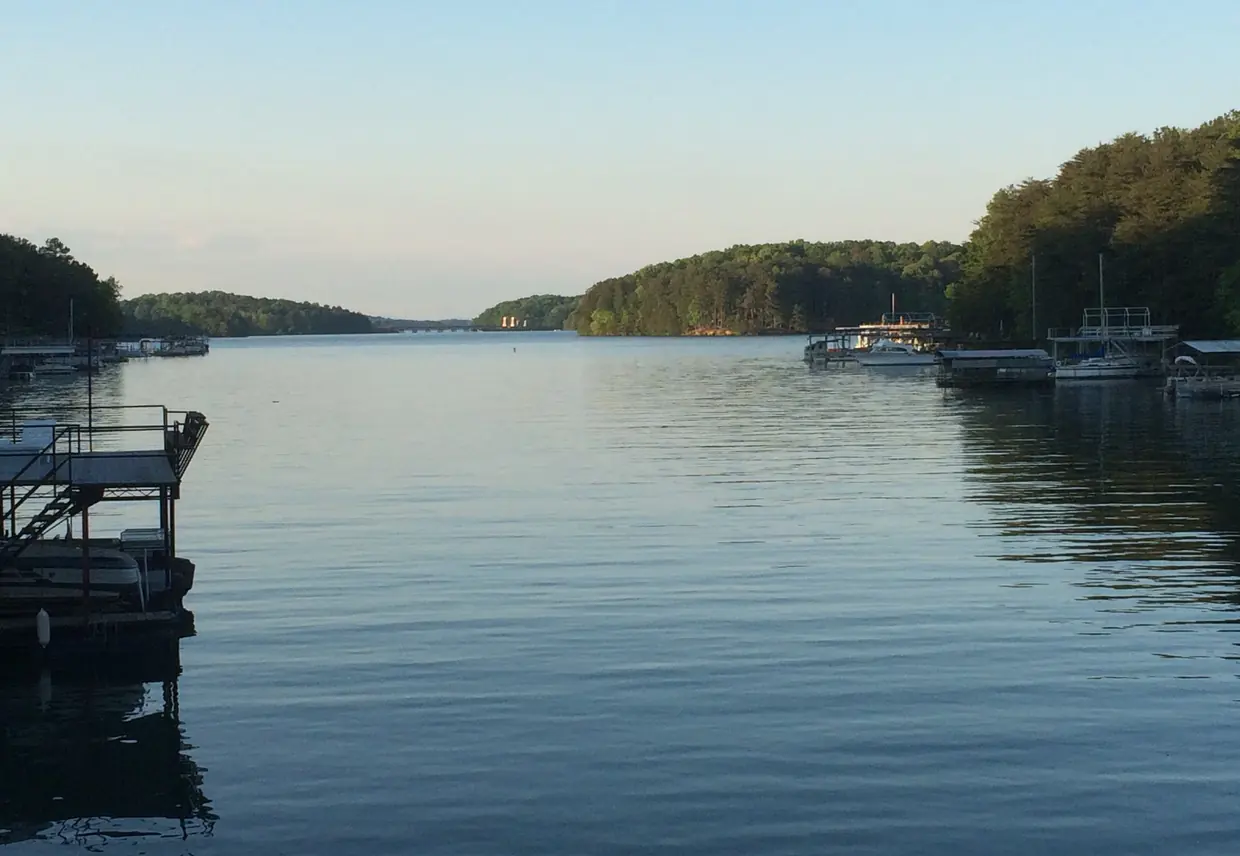
Each county on the lake has its own Environmental Health office and its own mix of sewer providers. We do not publish a share of lake homes on septic, because we found no published figure. What we can give you is the way to find out for the address you are looking at, and the lake rules that apply to any system near the water.
The Corps rule at the 1,085 line
Septic and the 1,085 line
- Corps policy: septic tanks and drain fields are not permitted on public (Corps) land below 1,085 feet, whatever their age, and existing ones there must be removed. The plan also says local health officials prohibit new septic systems below the 1,085-foot contour regardless of who owns the land. U.S. Army Corps of Engineers (archived page), checked 2026-10-19
- When Buford Dam was built, the government set a maximum flood elevation of 1,085 feet above mean sea level. Where that line fell on private land, it bought flowage easements. That land stays private, but the owner may not build habitable structures on it or change its contour. All purchased easements are recorded. U.S. Army Corps of Engineers (archived page), checked 2026-10-19
Two things follow for a buyer. A septic tank or drain field on Corps land has to go, whatever its age. And on private land below the 1,085 contour, the Corps plan reports that local health officials will not permit a new system. We found that statement in the Corps plan, not on a county page, so ask the county Environmental Health office how it applies to the lot. Read septic below the 1,085 line for the detail.
Who keeps septic records, county by county
Hall County Environmental Health (Georgia DPH District 2)
Septic records and permits · Hall County
Source: Hall County, checked 2026-10-19
Forsyth County Environmental Health (Georgia DPH District 2)
Septic records and permits · Forsyth County
Source: Forsyth County Environmental Health, checked 2026-10-19
Dawson County Environmental Health (Georgia DPH District 2)
Septic records and permits · Dawson County
Source: Georgia DPH District 2, checked 2026-10-19
Lumpkin County Environmental Health (Georgia DPH District 2)
Septic records and permits · Lumpkin County
Source: Lumpkin County, checked 2026-10-19
Gwinnett Environmental Health Department (GNR Public Health)
Septic records and permits · Gwinnett County
Source: GNR Public Health, checked 2026-10-19
| County | Septic record | Sewer and water | Building on a septic lot |
|---|---|---|---|
| Hall | Hall County Environmental Health, by email with the address | Hall County Sewer Services in parts of the county; water comes from city systems, not the county | Environmental Health review before most county building permits |
| Forsyth | Forsyth County Environmental Health | Forsyth County Water & Sewer; some addresses on Cumming Utilities | Environmental Health approval before a building permit |
| Dawson | Call Dawson County Environmental Health | Etowah Water & Sewer Authority or City of Dawsonville Water & Sewer | New systems must be permitted and inspected before use |
| Lumpkin | Lumpkin County Environmental Health, by email with the address | Lumpkin County Water and Sewerage Authority (availability request) | An approved septic permit with the building permit application |
| Gwinnett | Gwinnett Environmental Health (GNR Public Health); the county GIS may show a septic sketch | Gwinnett Department of Water Resources; some Buford-area addresses on City of Buford utilities | Existing-system evaluation available for a home sale |
Hall County
Hall County
- Hall County Environmental Health gives out the septic-system record for an address by email request; include the property address. The county says these requests can take up to 3 business days. The office is at 2875 Browns Bridge Road, 3rd Floor, Gainesville; phone 770-531-3973. Hall County, checked 2026-10-19
- In unincorporated Hall County, owners of property on a septic system must contact Hall County Environmental Health for review before applying for a county building permit. Some permits skip this step, such as re-roofs, replacement windows, doors or siding, demolition and trade-only permits. Hall County, checked 2026-10-19
- Hall County government does not provide water service. Water comes from a city system, such as the City of Gainesville, Flowery Branch, Oakwood, Braselton, Buford, Clermont or Lula, depending on the address. Hall County, checked 2026-10-19
- Hall County Public Works & Utilities runs Hall County Sewer Services, which serves parts of the county through capacity agreements that include the Spout Springs and Flowery Branch water reclamation facilities and the City of Gainesville. The county publishes a sewer district boundary map and takes Sewer Availability Letter requests. Hall County, checked 2026-10-19
Forsyth County
Forsyth County
- Forsyth County Environmental Health says that if you plan to build, remodel, or add a building or pool on property served by a septic system, you must get its approval before you can get a building permit. It says applications can take twenty business days or more. Forsyth County Environmental Health, checked 2026-10-19
- The Forsyth County Department of Water & Sewer provides county water and sewer service; customer service is (770) 781-2160. To start service you submit a New Service Request with a copy of your driver's license and a signed lease or purchase agreement. Forsyth County, checked 2026-10-19
- Some Forsyth County addresses are in the City of Cumming's utility system instead. Cumming Utilities, at Cumming City Hall, 100 Main Street, (770) 781-2020, publishes a Water and Sewer Service Area (WSSA) map. Cumming Utilities, checked 2026-10-19
Dawson County
Dawson County
- District 2 Public Health says records of all approved septic systems are kept at the county Environmental Health office, new systems must be permitted and inspected before use, and not every lot is suitable for septic. To get a record for an address, call Dawson County Environmental Health. Georgia DPH District 2, checked 2026-10-19
- The City of Dawsonville lists two public water and sewer providers: the Etowah Water & Sewer Authority, (706) 216-8474, and the City of Dawsonville Water & Sewer Department, (706) 265-3256. It lists septic under Dawson County Environmental Health. City of Dawsonville, checked 2026-10-19
- The Etowah Water & Sewer Authority says it was created to serve Dawson County, draws water from the Etowah River, and serves about 9,300 water customers but only about 376 sewer customers. Its first wastewater plant was built in 1996 to serve the outlet mall and businesses along the GA 400 corridor. Etowah Water & Sewer Authority, checked 2026-10-19
The Etowah Water & Sewer Authority’s own figures, as it states them, show far more water customers than sewer customers, so do not assume a Dawson address with public water also has public sewer. Ask the provider.
Lumpkin County
Lumpkin County
- Lumpkin County Environmental Health, a section of the Georgia Department of Public Health, takes individual septic-record requests by email: send the property address to lumpkineh@dph.ga.gov and allow up to 48 hours. The office is at 342 Courthouse Hill, Suite B, Dahlonega (706-867-2730). Lumpkin County, checked 2026-10-19
- In unincorporated Lumpkin County, a building permit application needs an approved septic permit, and an approved soil and erosion plan is required for land disturbance of an acre or more or for disturbing land within 200 feet of state waters. Lumpkin County, checked 2026-10-19
- The Lumpkin County Water and Sewerage Authority (LCWSA) was created by the Georgia General Assembly in 1984 to provide water and sewer service in Lumpkin County. It is not a taxing body and runs on water and sewer fees. To ask whether water or sewer lines reach an address, send LCWSA its Water and Sewer Availability Request. Lumpkin County, checked 2026-10-19
- For private wells, the Lumpkin County Water and Sewerage Authority points owners to the Lumpkin County Cooperative Extension Office for water testing (706-864-2275). Lumpkin County Environmental Health also posts a water test application. Lumpkin County, checked 2026-10-19
Gwinnett County
Gwinnett County
- Gwinnett Water Resources says the easiest way to tell whether a home is on septic is its county water bill: a sewer-use charge means public sewer, and a 'Sewer Amount Charged' of $0.00 very likely means septic. Environmental Health keeps records for septic systems installed since 1959, and the county advises home buyers to have a septic system inspected before buying. Gwinnett County, checked 2026-10-19
- Gwinnett County's free online GIS Data Browser lets you find any land parcel, property owner, street, address or intersection in the county. Where available, it also shows a sketch of a home's septic system and past septic repair permits. Gwinnett County, checked 2026-10-19
- Septic permits, records and existing-system evaluations in Gwinnett are handled by the Gwinnett Environmental Health Department of GNR Public Health (Gwinnett, Newton and Rockdale), 455 Grayson Hwy, Suite 600, Lawrenceville, GA 30046, phone 770-963-5132. For a home sale, GNR's Existing Septic System Evaluation Application lists 'Loan Closing for Home Sale or Refinance' as a reason, and the office asks for 10 working days to review and visit the site. GNR Public Health, checked 2026-10-19
- Gwinnett County's Department of Water Resources (DWR) manages the county's public water, sewer and stormwater systems. Lake Lanier is the county's main water source, treated at the Lanier and Shoal Creek filter plants. Gwinnett County, checked 2026-10-19
- The City of Buford provides water, sewer, gas and electric service to various areas, so some addresses near Buford are on city utilities rather than Gwinnett DWR. Buford's utility customer service number is 678-889-4600. City of Buford, checked 2026-10-19
The water-bill test
Gwinnett spells out the quickest check: a sewer charge on the county water bill means public sewer, and a zero sewer amount very likely means septic. The idea is worth using anywhere on the lake. Ask the seller for a recent water and sewer bill, see who sends it and whether it charges for sewer, then confirm with that provider. In Hall County the county provides no water, so the water bill may come from a city system while sewer, if any, comes from someone else.
Buffers that affect a drain field
State and county buffers
- Under Georgia's Erosion and Sedimentation Act, 'State Waters' include lakes and reservoirs, natural or artificial, as well as rivers, streams and creeks. Lake Lanier, a reservoir, is a state water. Georgia EPD, checked 2026-10-19
- Georgia's state-mandated buffer is 25 feet (50 feet on trout waters), measured horizontally from the point where vegetation has been wrested by normal stream flow or wave action. On an impoundment such as a lake, EPD says the buffer is measured from that point of wrested vegetation, not from normal pool elevation unless the two coincide. Georgia EPD, checked 2026-10-19
- Hall County also requires a 50-foot undisturbed natural vegetative buffer on both banks of a stream, plus a further 25-foot setback where impervious cover is not allowed. Clearing, grading and building in the stream buffer need a stream buffer variance, and no septic tanks or drain fields are allowed in the buffer or setback. Hall County, checked 2026-10-19
- Gwinnett's development code requires a 50-foot undisturbed buffer on both banks of a stream, measured from the top of the bank. Beyond it is another 25-foot setback where impervious cover (buildings, parking, driveways, concrete retaining walls) is prohibited. No septic tanks or drain fields are allowed in the buffer or setback, and work in them needs a variance. Gwinnett County, checked 2026-10-19
- Hall County's code waives side and rear yard minimums on residential lots that adjoin the Corps of Engineers property line, provided the septic system sits wholly on private property or is otherwise lawfully permitted. New subdivision plats next to the reservoir must show the 1,071-foot contour ('Normal Lake Level') and the 1,085-foot contour ('Maximum Lake Level'). Hall County, checked 2026-10-19
- Dawson County requires a 50-foot undisturbed buffer from the bank of creeks, ponds, lakes, rivers and streams (150 feet in watershed overlays). An erosion-control plan with a land disturbance permit is needed when a project disturbs an acre or more, or comes within 200 feet of creeks, lakes, ponds, rivers or streams. Dawson County, checked 2026-10-19
Buffers are measured from different points in different codes, and most Lake Lanier shoreline is Corps land with its own rules on top. If a lot has a creek or a drainage on it, or the house sits close to the Corps line, the space left for a drain field can be smaller than the lot looks. Ask the county Environmental Health office and the county development office before you plan a repair, a replacement system or an extra bedroom.
What a septic record tells you, and what it does not
A county record shows what was permitted: when, for how many bedrooms, and often a sketch of where the tank and drain field went. It does not tell you whether the system works today, whether someone added a bedroom later, or whether the drain field was repaired without a permit. Compare the record with the house you see, and pay for an inspection. If no record turns up, treat that as a question for the seller and Environmental Health, not as proof the home is on sewer.
If you are selling
Request the septic record and a recent water and sewer bill before you list, and keep any pumping or repair receipts. Buyers on Lake Lanier ask early, and an answer in the listing file saves days in due diligence. Our seller guide lists the other documents to gather.
Septic checks before an offer
- Get the county septic record for the address and compare the permitted system with the number of bedrooms.
- Ask the seller for a recent water and sewer bill.
- Ask the sewer provider whether the address is on, or can reach, public sewer.
- Find the tank and drain field on the survey, relative to the Corps line and the 1,085 contour.
- Have the system inspected; in Gwinnett, GNR takes existing-system evaluations for a home sale.
- If you plan to add on, ask Environmental Health before you count on a building permit.
- On a private well, have the water tested.
Questions buyers ask
Can I have a septic system below the 1,085-foot line?
Corps policy: septic tanks and drain fields are not permitted on public (Corps) land below 1,085 feet, whatever their age, and existing ones there must be removed. The plan also says local health officials prohibit new septic systems below the 1,085-foot contour regardless of who owns the land.
How do I get septic records in Hall County?
Hall County Environmental Health gives out the septic-system record for an address by email request; include the property address. The county says these requests can take up to 3 business days. The office is at 2875 Browns Bridge Road, 3rd Floor, Gainesville; phone 770-531-3973.
Source: Hall County
Who handles septic permits in Forsyth County?
Septic permits in Forsyth County are handled by Forsyth County Environmental Health (Georgia DPH District 2), now at 2435 Freedom Pkwy, Suite 2400, Cumming, GA 30041; phone 770-781-6909. Its fee list includes a Septic Record Request ($30), a Performance Evaluation of an existing septic system ($150) and a Pre-purchase Site Evaluation ($150).
How can I tell if a Gwinnett home is on sewer or septic?
Gwinnett Water Resources says the easiest way to tell whether a home is on septic is its county water bill: a sewer-use charge means public sewer, and a 'Sewer Amount Charged' of $0.00 very likely means septic. Environmental Health keeps records for septic systems installed since 1959, and the county advises home buyers to have a septic system inspected before buying.
Source: Gwinnett County
Who provides water in Hall County?
Hall County government does not provide water service. Water comes from a city system, such as the City of Gainesville, Flowery Branch, Oakwood, Braselton, Buford, Clermont or Lula, depending on the address.
Source: Hall County
Is there a buffer along the Lake Lanier shoreline for building?
Georgia's state-mandated buffer is 25 feet (50 feet on trout waters), measured horizontally from the point where vegetation has been wrested by normal stream flow or wave action. On an impoundment such as a lake, EPD says the buffer is measured from that point of wrested vegetation, not from normal pool elevation unless the two coincide.
Source: Georgia EPD
Next step
Run the address through the waterfront due-diligence checker, and read the 1,085 line if the house sits low on the lot.
Rules, rates, maps and lake levels change. Every rule on this page links to the office that sets it; confirm with that office before you rely on it.